
EightyFive
Manual · version 1.4
A six-voice polysynth in the 1985 Roland JX-8P layout: two oscillators with sync and cross modulation, a mixer with its own envelope, a switched high-pass, drive into a 24 dB ladder filter, two envelopes, one LFO with a delayed fade-in, chorus I and II, unison and portamento. It reads and writes the JX-8P's own SysEx tones, and the original's factory bank is built in. Own code, calibrated to the original's response from its editors and recordings.
In my words
I have had a JX-8P for 30 years, and I wanted something that fits into my workflow so I can do everything in the box, and get some of that warmth the JX-8P has. Mine came without the PG-800, which made changing a sound a pain. Every parameter through the one slider and the display.
So the plugin is also a way to get at the sounds. Every control on a panel in front of you, automation from the DAW, and an easy way to program a sound in. The original's tones load as they are, so the starting points are the ones I know.
If you want the official emulation of the JX-8P, go to Roland. The JX-8P Model Expansion for Zenology is really good. This one is open code in this suite's layout, reads the original's tones, and is free.
Where it goes
On a software instrument track. Brass, strings, pads, sync leads and basses, the sounds that layout was bought for in 1985. Six voices, as the original. UNISON stacks all six on one note.
Programs
Init Saw, then the original's factory bank, tones 1 to 32 from Piano 1 to PsychMello, read at start-up from its SysEx dump through the same reader LOAD uses, so these are the original's own settings on this panel. After them, under "bank B, built here", 32 programs built on this panel for the names of the original's second preset bank, which is not available as data. The < and > buttons step through the programs, the box picks one.
LOAD reads a JX-8P SysEx file, a 32-tone bank or a single tone as the original transmits them and as librarians save them, and adds its tones after the factory programs under the file's name. The loaded bank is saved with the project. SAVE writes the current program as a JX-8P tone file, or the loaded bank (the factory bank if none is loaded) as a 32-tone bank file, so programs made here can go to a real JX-8P or any other editor. What the original has no place for (drive, unison, portamento, bend, output) is left out of the file.
Piano 1 and Piano 3 carry +6 dB on OUTPUT. On the original's levels they sit well under the rest of the bank; the trim is outside the tone, so the tone stays as the dump has it.
Controls
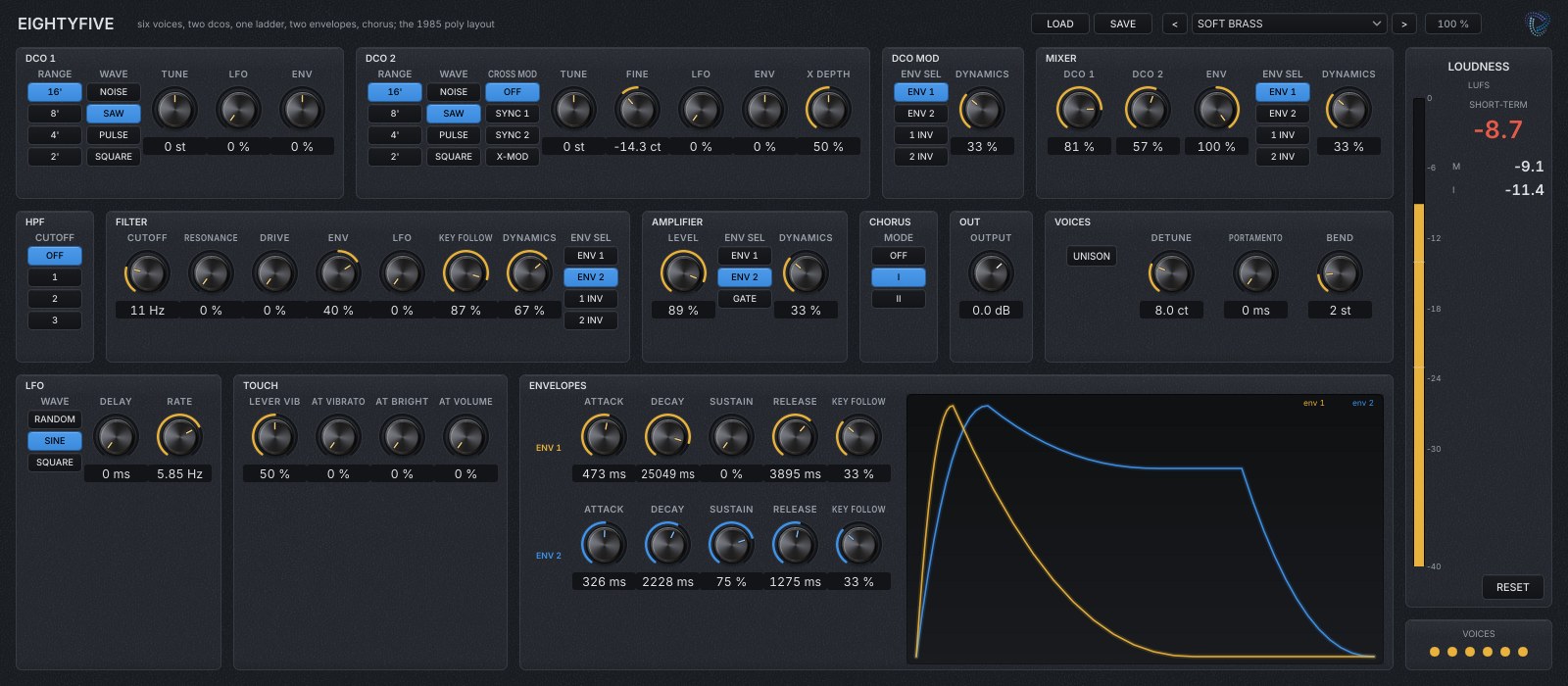
The panel is three bands: sound generation, shaping, modulators.
| Block | What it does |
|---|---|
| DCO 1, DCO 2 | RANGE 16', 8', 4', 2'. WAVE noise, saw, pulse, square. TUNE ±12 semitones. LFO, the LFO's depth on pitch, half an octave each way at full. ENV, the pitch envelope, −100 to +100 %, 2.6 octaves at full, from the envelope chosen in DCO MOD. DCO 2 adds FINE (±50 cents), CROSS MOD (off, sync 1, sync 2, x-mod) and X DEPTH. In both sync modes DCO 2 is reset by DCO 1; in sync 2 DCO 1's square is also OR-ed onto DCO 2's wave, as on the original. |
| DCO MOD | ENV SEL, envelope 1 or 2, straight or inverted, for both oscillators. DYNAMICS, how much velocity scales the envelope depth. |
| MIXER | DCO 1 and DCO 2 levels. ENV, an envelope on the DCO 2 level, −100 to +100 %, with its own ENV SEL and DYNAMICS. |
| HPF | Off, 1, 2, 3: 120, 300 and 700 Hz. |
| FILTER | CUTOFF 2 Hz to 20 kHz; below about 30 Hz the filter is closed and the setting only decides how far the envelope has to push before it opens. RESONANCE rings hard at full, a decay of about 5 ms at 1 kHz as measured on the original, but does not sing on its own. DRIVE, up to +18 dB into a soft clip before the ladder. ENV, −100 to +100 %, 13.6 octaves at full. LFO, 5.3 octaves each way at full. KEY FOLLOW, 1.29 octaves per octave at full, neutral at F#2. DYNAMICS, velocity scales the envelope depth through one of three curves: 1 soft, 2 linear, 3 hard. ENV SEL. |
| AMPLIFIER | LEVEL, exponential, 24 dB over the knob. ENV SEL, envelope 1, envelope 2 or GATE (on while the key is down). DYNAMICS, the same three curves. |
| CHORUS | Off, I, II. Rates 0.81 and 1.21 Hz, delay swept 1.2 to 3.7 ms, as measured on the original. Stereo, the two sides a quarter cycle apart, so a mono voice stack comes out wide. |
| OUT | OUTPUT −24 to +12 dB, with a soft ceiling from −3 dBFS so a six-voice chord at full level does not clip. |
| VOICES | UNISON, all six voices on one note. DETUNE, the spread of the outer voices, 0 to 30 cents. PORTAMENTO 0 to 2.5 s. BEND, the pitch bend range, 0 to 12 semitones. |
| LFO | WAVE random (sample and hold), sine, square. DELAY, after each note the LFO is held off for half the time and fades in over the other half, 0 to 4 s. RATE 0.01 to 30 Hz. Each voice has its own LFO, so each note gets its own fade-in. |
| TOUCH | The performance settings, which on the original were global and not part of a tone, so a program change leaves them alone. LEVER VIB, the modulation wheel to vibrato, a quarter tone each way at full, without the LFO delay. AT VIBRATO, AT BRIGHT (aftertouch opens the filter, four octaves at full) and AT VOLUME (up to +6 dB). Channel and polyphonic aftertouch both count. |
| ENVELOPES | Two, each with ATTACK 1 ms to 20 s, DECAY and RELEASE 1 ms to 60 s, SUSTAIN and KEY FOLLOW (higher notes get shorter envelopes), beside a display of their shapes. The curves are RC: the attack bends into its top, decay and release are exponential. |
How the tones are read
The tone parameters are mapped onto this panel on the scales the JX-8P editors use for the original's response, and checked against recordings of the original: the cutoff curve, the envelope times (10 ms at 13, half a second at 64, 26 s at 127), the LFO rate curve, the LFO delay, the coarse tune table (the original's slider is not linear in semitones), the envelope modes, the resonance ceiling and the chorus rates. The sync 2 waveform and the direction of the inverted pitch envelope come from the original's E. Bass, Stab Brass and Bubbles in a recording.
Under the hood
The voices run at twice the host rate and are summed to mono; chorus, output level and the ceiling run at the host rate. The oscillators are band-limited saw, pulse (25 %) and square with white noise as the fourth wave, and they free-run, so no note starts from the same phase. Hard sync is band-limited too. The ladder is four one-pole stages with the loop solved per sample and a soft limit on the feedback, so resonance compresses rather than runs away. Every voice has a DC blocker after the filter, like the coupling capacitors in the original. Voice stealing takes an idle voice, then the oldest releasing voice, then the oldest. Sustain pedal held notes are released when the pedal goes up.
The official one
If you want the official emulation of the JX-8P, go to Roland. The JX-8P Model Expansion for Zenology is really good. EightyFive is open code, reads the original's tones, and is free.
Loudness meter, level-matched bypass and mono handling work the same in every plugin. Common to all plugins