
Vocal Chain
Manual · version 0.4
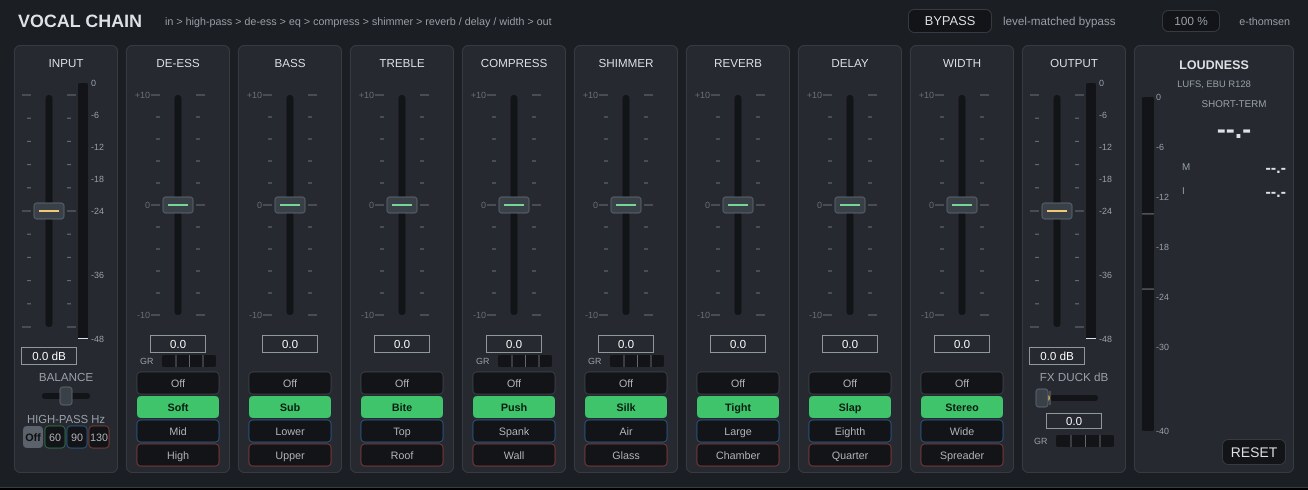
One window for a lead vocal. High-pass, de-esser, two-band EQ, compressor, shimmer, reverb, tempo-synced delay and width, in that order, with FX ducking.
The idea
Each module is a column with a fader and a four-way selector, Off plus three characters. The character sets the kind of processing, the fader the amount. Frequencies, ratios and times live inside the characters.
In every column 0 is the default amount, +10 the maximum and -10 none. Bass and Treble are the exception, ±8 dB with 0 as bypass. Shimmer is bipolar. Positive adds air, negative tames it, 0 is bypass.
Signal flow
Input → Balance → High-pass → De-ess → EQ → Compress → Shimmer → dry plus (Reverb, Delay, Width) → Output → loudness meter. The three effects run in parallel and are added to the dry signal. The FX duck pulls their sum down while the vocal is present.
Columns
| Control | What it does |
|---|---|
| Input | Sensitivity, ±10 dB, with a peak meter. Balance ±6 dB under it. High-pass row: Off, 60, 90 or 130 Hz, 12 dB per octave. |
| De-ess | Characters set the band. Soft above 5 kHz, Mid above 6.5 kHz, High above 8 kHz and firmer. The fader shifts the threshold; +10 is much more de-essing. The detector compares the band with the whole signal, so it reacts to an ess that stands out, not to absolute level, and leaves bright vowels alone. Gain-reduction bar. |
| Bass | ±8 dB. Sub: shelf at 70 Hz. Lower: bell at 160 Hz. Upper: bell at 320 Hz. |
| Treble | ±8 dB. Bite: bell at 3.2 kHz. Top: shelf at 8 kHz. Roof: shelf at 13 kHz. |
| Compress | Push: 3:1, slow, soft knee. Spank: 6:1, fast, firm. Wall: 20:1 with a soft clip, near a limiter. The fader shifts the threshold, +10 heavy, -10 almost none. Gain-reduction bar. |
| Shimmer | An exciter with its own dynamic control. Positive generates harmonics from the 3 to 7 kHz region and adds them above the character's corner (Silk 8 kHz, Air 10 kHz and more of it, Glass 6 kHz with tight control), giving a dull voice air it did not have. Negative presses the air band down when it stands out. Both directions are dynamic. Gain-reduction bar. |
| Reverb | Tight (about 1 s, dark), Large (about 3 s), Chamber (about 2 s, brighter, more motion). Fader is the wet level; -10 is silent. |
| Delay | Slap (1/16), Eighth (1/8), Quarter (1/4), synced to the song tempo, with a dulled feedback path. Fader is the wet level. |
| Width | A micro-pitch doubler. Stereo (±6 cents), Wide (±12 cents), Spreader (±9 cents with offset delays and extra width). Fader is the wet level. |
| Output | ±10 dB with a peak meter. FX duck under it, 0 to 12 dB, with its own reduction bar. The effects sum is pulled down by this much while the vocal is present and released in the gaps, so effects bloom between phrases. |
Header
BYPASS is level-matched, with the match taken at the moment you press it and shown in dB next to the button. Press it with the chain settled, not during a gap.
Working with it
- Start with every module on its first character and all faders at 0. That is already a working vocal chain.
- The gain-reduction bars show whether De-ess, Compress, Shimmer and the FX duck are acting before you judge their sound.
- For a tuning pass, switch on one module at a time with the others Off and compare with BYPASS.
- Set the compressor before Shimmer and the effects. It decides the level they see.
Under the hood
The compressor's clip stage and the exciter run at twice the sample rate behind a 63-tap half-band filter. Image rejection is about 110 dB and the response is flat to 19 kHz at 44.1 kHz. Latency is a fixed 31 samples (0.6 ms at 48 kHz), reported to Logic. The bypass path is delayed by the same amount. Everything else in the chain is zero-latency.
The de-esser and the shimmer split the signal with 4th-order Linkwitz-Riley crossovers, which sum back exactly. The wet faders fade to silence on a cosine curve below 0, so the first steps are gentle.
Loudness meter, level-matched bypass and mono handling work the same in every plugin. Common to all plugins